
02 July 2026 · amalfi coast
Charter Logbook: A Week on the Amalfi Coast aboard Pershing 9X SOPHIA
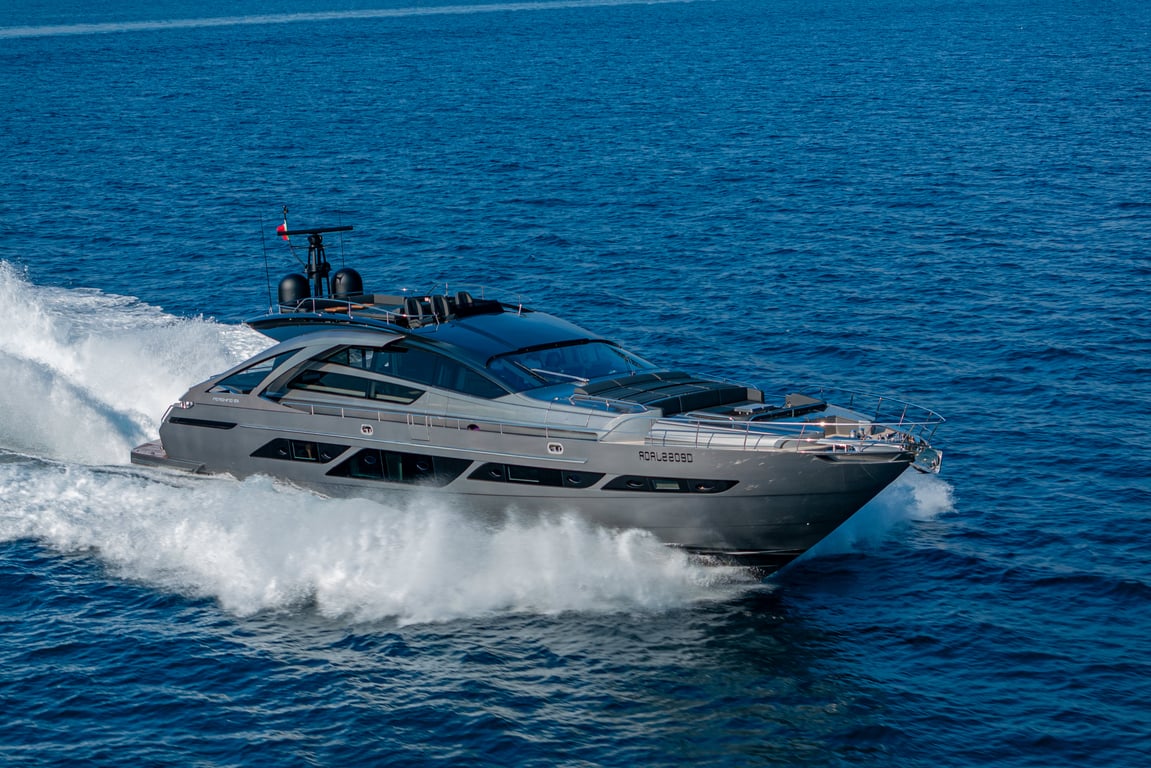
The Riviera, the Balearics, the Cyclades, Dalmatia and Sardinia are all behind me in this series now — but the Amalfi Coast kept coming back to me every time I closed the laptop. Everyone knows this coastline from postcards: vertical towns clinging to the rock, lemon groves above the sea, Capri on the horizon. I wanted to find out whether it looks the way it does in your head once you see it from the water. I boarded SOPHIA in Naples — a 2023 Pershing 9X, 28 metres from the Italian yard Pershing (Ferretti Group): nine berths in four cabins, four professional crew with an Italian captain and chef, twin MTU engines and a 32-knot cruising speed at which "too far for one day" simply stops existing. I wrote this week down day by day — because on the Amalfi Coast speed isn't a toy, it's the key: it lets you be in the most beautiful places at the moment when no one else is there yet.
Day 1 — Naples, and the first evening in Sorrento
We came aboard in the late afternoon in Naples, under Vesuvius, which from the water looks far gentler than it deserves to. I didn't want to spend the first night in the noise of the port, so we ran under an hour across the bay to Sorrento — a clifftop town that at dusk smells of lemons and warm stone. The first evening was exactly as it should be: the aft deck, a glass of Aperol Spritz and the lights climbing the hillside above us. The chef served the first fresh fish — a local pezzogna baked whole, good olive oil, a glass of chilled Lacryma Christi, the white wine from the vineyards on the slopes of Vesuvius. The phone went quiet on its own.
Day 2 — Sorrento to Capri, before anyone else
I woke at first light — my favourite moment of the day on the water. I climbed up to the flybridge with a coffee and simply watched the sun come up behind the peninsula; the sea was like the surface of a lake, and Capri hung on the horizon in a pink haze. This is where the Pershing showed what it is for: instead of waiting until the island fills with ferries and day-trippers, we set off early, and in under forty minutes we were sitting beneath the Faraglioni — the three famous rocks that rise straight out of the sea — with them almost to ourselves. We slipped into the Blue Grotto while the water was still glassy and the light came in under the rock and lit the whole cave that unreal cobalt. Then a long swim in the shade of the cliffs. In the afternoon we went ashore in Capri town for the obligatory gelato at the parlour on the Piazzetta and a walk under the bougainvillea. The Seabob stayed in the garage — what for, when the water itself is the attraction.
Day 3 — Positano, the postcard that turns out to be real
On the third day we ran across to Positano, and there I understood why this town ends up on every postcard: the pastel houses spill down an almost vertical slope to the sea, and the majolica dome of the church of Santa Maria Assunta glows in the sun like a jewel. We lay at anchor right below the town. The water was so warm and so clear that no one wanted to get out of it — we floated in it for hours, looking up at that impossible town. In the evening, dinner on board: spaghetti with seafood and Amalfi lemon, then a small glass of limoncello, which nobody refuses here.
Day 4 — Amalfi, the Emerald Grotto and a day when nothing is required
We left the fourth day completely empty — no bay "to tick off". On the way we stopped below Conca dei Marini at the Emerald Grotto, where the light coming in under the water turns the whole cave green, like a mirror image of the Blue Grotto. Then we anchored below Amalfi itself — a town that was once a maritime power rivalling Venice, and today is a cathedral at the top of a staircase and the smell of lemons. High above us, on the ridge, hung Ravello with the gardens of Villa Rufolo — but we stayed on the water: a mattress on the bow, a long swim, a nap, a book. In the evening the chef served buffalo mozzarella straight from Campania and fish off the grill. There are worse ways to spend a day.
From my experience as a broker: on the Amalfi Coast three things decide whether a week works, and none of them is in the brochure. The first — this coast has almost no sheltered harbours, and most of your time at rest is spent at anchor, exposed to the swell; a yacht with stabilisers that also work at anchor (and SOPHIA is one) is the difference between dinner at a level table and chasing your glass across it. The second — in July and August Positano and Capri are besieged, and the best anchorages are often taken by mid-morning, which is exactly why you cruise at dawn and not after breakfast. The third — this coastline has protected zones and anchoring restrictions, around Punta Campanella and the Li Galli islands among others, so a captain who knows the current rules and the mooring buoys is worth every euro. A good week on the Amalfi Coast isn't a list of towns; it's a plan built around the forecast, the crowds and the regulations. That part I take on myself.
Day 5 — The Li Galli islands and the plate worth sailing for
On the fifth day we ran out to the Li Galli islands — three small islets that legend insists were the home of the Sirens from the Odyssey, and that in the twentieth century belonged in turn to two great dancers: first Léonide Massine, then Rudolf Nureyev. The water around them is glassy and deep navy; we swam with no plan and no watch. For lunch the captain moved us a little further, to Marina del Cantone below Nerano, for the one dish worth coming here for: spaghetti alla Nerano — pasta with fried courgette and provolone del Monaco cheese, painfully simple and completely brilliant. We came back to anchor already full of sun.
Day 6 — The run where "too far" turns into "why not": Ischia and Procida
On the sixth day we made the jump that tempts you from the Amalfi Coast but usually feels "too far": right across the Bay of Naples to its other, western side — to Ischia and Procida. On a slow yacht that's half a day each way; on SOPHIA, at 32 knots, "too far" turned into "why not", and a little over an hour later we were lying off Ischia. It is a different world from Amalfi — a thermal island, with hot springs bubbling up right in the coves, the fishing village of Sant'Angelo and the Aragonese Castle on its own rocky islet. In the afternoon we moved across to neighbouring Procida — the least discovered of the bay's islands, with the harbour of Marina Corricella, where the fishermen's houses were painted every colour at once so the crews could pick out their own from the sea. In the evening we came back to a quiet anchorage to fall asleep in silence.
The Amalfi Coast doesn't try to dazzle you — it is simply more beautiful than good sense allows. And speed on this coast isn't for rushing; it's for standing in the most beautiful place at the moment when no one else is there yet.
— Tomasz Wrzesiński, yacht broker, Monaco
Day 7 — Back to Naples
The last day is my favourite moment of the whole week. There wasn't far to go back to Naples, so there was no rush in the morning — coffee on the flybridge, smooth early water under the bow, everyone noticeably darker and noticeably quieter than at the start. Vesuvius rose in front of the bow again, this time on the side of goodbye. I stepped ashore already working out in my head which town we had skipped by mistake. A good sign: it means you have to come back.
What it costs, and what's worth knowing
This particular yacht — SOPHIA, a Pershing 9X (2023, 28 m, 9 guests in 4 cabins, 4 crew, stabilisers at anchor and underway) — charters on the Amalfi Coast from €79,000 a week outside the peak, and around €89,000 in July and August, plus VAT at the Italian rate and APA of roughly 30% — that is, very roughly €24,000–27,000 for fuel, provisioning, marinas and mooring, plus port fees. What exactly hides inside those lines I break down in separate pieces: what APA is, and what a charter bill is actually made of.
And the thing you won't read in any listing: on the Amalfi Coast the same week can be a fight for an anchorage in the August peak, or the calmest holiday of your life in September, when the water is still warm and Positano can breathe again. The difference is made by the dates, by a daily rhythm built around the crowds, and by a captain who knows the rules and knows which side of the peninsula to tuck behind when the wind gets up. That is exactly the part I take on myself. You have the map; it's still worth having a guide.
Want to actually sail this route?
SOPHIA cruises the central Mediterranean in summer — the Amalfi Coast, the Pontine Islands, Sardinia and the Italian Riviera. Tell me when you're going and who's coming, and I'll build the route around you, with a crew that knows this coast and its speed by heart. See this charter →
This is the sixth episode of the "Charter Logbook" series — after the French Riviera, the Balearics, the Cyclades, Dalmatia and Sardinia. In the episodes to come we'll sail further still — every route has its own rhythm.