
26 June 2026 · Charter Logbook
Charter Logbook: A Week in Sardinia & the Costa Smeralda aboard Ferretti 780 SEA DIAMOND
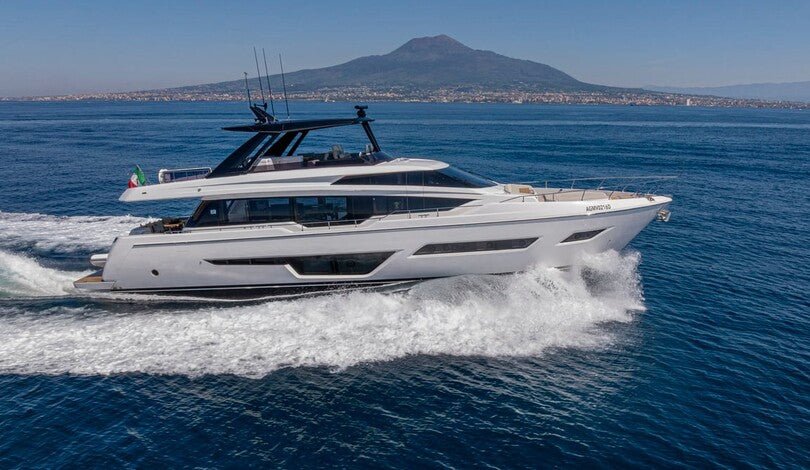
The Riviera, the Balearics, the Cyclades and Dalmatia are already behind me in this series — but northern Sardinia had been a blank on my map for far too long. Other people describe the water around the Costa Smeralda and the La Maddalena Archipelago as "Caribbean," and I finally wanted to see for myself whether that was true. I boarded SEA DIAMOND in Olbia — a brand-new 2025 Ferretti 780, 24 metres of Italian craftsmanship: eight berths in four cabins, a four-strong Italian crew with captain, chef and stewardess, and a stabilised hull that keeps the dinner table on the aft deck dead level even in a light chop. I kept this week day by day — because northern Sardinia is a different kind of luxury from anything I've shown so far. Here it isn't about the harbour where you're seen; it's about the bay where the water is a colour you struggle to believe.
Day 1 · Olbia and a first evening in Porto Cervo
Olbia → Porto Cervo
We came aboard in the late afternoon in Olbia — the gateway to the Gallura region and the whole Costa Smeralda. I didn't want to start in the crowds, but Porto Cervo has to be seen on the first evening: it's the heart of this coast, a marina dreamed up from nothing in the 1960s by the Aga Khan, who bought a stretch of wild shoreline and decided to turn it into the most exclusive corner of the Mediterranean. An hour of easy cruising north and we were moored in one of the most famous marinas in the world. The first evening was exactly what a first evening should be: the aft deck, a glass of Aperol Spritz, and a view of the Piazzetta lighting up after dark like a little stage. The chef served the first fresh fish — grilled dentex, good olive oil, a glass of chilled Vermentino di Gallura, the local white that tastes here as though it were made for this water. The phone fell silent on its own.
Day 2 · Dawn and the coves of the Costa Smeralda
Porto Cervo → Cala di Volpe → Liscia Ruja
I woke at dawn — it's my favourite moment of the day on the water. I climbed up to the flybridge with a coffee, under the solid hard-top, and simply watched the sun rise over the granite hills of Gallura. The sea was like a sheet of glass, not a ripple on it, only a pinkening sky and the scent of the maquis drifting off the land. That boundless calm before the coast wakes up — that's what you come here for.
We spent the day the way the Costa Smeralda was meant to be enjoyed: hopping from cove to cove. First the anchor down off Cala di Volpe, then a long afternoon at Liscia Ruja — a wide, pale beach where the water is so clear that the yacht's shadow lay on the sandy bottom a few metres below. On SEA DIAMOND the whole stern opens up — the portellone folds down and turns the platform into a private terrace right at the water's edge. From there it's easiest to do what I love most: slide into the warm, azure water and simply float. The Seabob stayed in the locker. Why bother, when the water itself is the attraction.
Day 3 · La Maddalena — water from another sea
Costa Smeralda → Spargi, Cala Corsara
On the third day we entered the real reason you sail to the north of Sardinia — the La Maddalena Archipelago, a national park scattered between Sardinia and Corsica, dozens of islands and islets of pink-grey granite. We anchored off Spargi, in Cala Corsara, and there I understood where all those comparisons to the Caribbean come from: the water is a bright turquoise shading into jade, and the bottom is so pale that the boat looks as though it's hanging in mid-air. We swam for hours, no plan and no watch. The chef made fregola with clams for lunch — that round, toasted Sardinian cousin of couscous — and that was the whole agenda for the day.
Day 4 · Budelli, the pink beach, and a day when nothing has to happen
Spargi → Budelli, Spiaggia Rosa → Cala Santa Maria
We left the fourth day completely empty — no bay to "tick off." We eased up to Budelli, to the famous Spiaggia Rosa — the beach whose sand really does carry a pink tint from crushed shells and grains of coral algae. You don't go ashore here: the beach has been strictly protected since the 1990s and is admired only from the water — and rightly so, because that's exactly why it's still pink. We moved on to anchor at Cala Santa Maria, a mattress on the foredeck, a long swim, a nap, a book. Dinner aboard that evening: spaghetti with sea urchins and local bottarga grated in shavings over the pasta, and to finish a glass of mirto — the Sardinian myrtle liqueur without which no dinner here ever ends. There are worse ways to spend a day.
A broker's note. From my experience, three things decide a good week in northern Sardinia that you won't find in any brochure. First — the La Maddalena Archipelago is a national park; entering and anchoring requires a daily permit, and the most beautiful bays have marked zones and mooring fields, so a captain who knows the rules is worth every cent here. Second — in August Porto Cervo and the Costa Smeralda burst at the seams, and a marina berth can be pricier and harder to find than the charter itself; July or September is often the smarter choice. Third — the maestrale, the dry north-westerly, can change which side of an island you choose to sleep behind from one day to the next. A good week in Sardinia isn't a list of beaches; it's a plan built around the forecast and around the permits. That part I take on myself.
The Costa Smeralda doesn't try to dazzle you with luxury, though it easily could. It does something harder — it shows you water in a colour you won't forget, and it makes you stop looking at your watch.
— Tomasz Wrzesiński, yacht broker, Monaco
Day 5 · The hop to Corsica — Bonifacio
La Maddalena → Bonifacio (Corsica) → anchorage on the Sardinian side
On the fifth day we made the crossing that tempts everyone from the north of Sardinia: across the Strait of Bonifacio to Corsica. It's barely a dozen miles, but the far side of the strait looks like another world — Bonifacio stands on white limestone cliffs that the sea has undercut so deeply the old town seems to hang over the water. We slipped into that narrow, fjord-like harbour beneath the citadel and for a moment nobody said a word; it's one of those entrances you remember. In the afternoon, a walk through the haute ville, a coffee on the ramparts looking back across the strait and — obligatory — an ice cream on the way down, in a narrow lane, among a crowd that had simply come out for a stroll. In the evening we crossed back to the Sardinian side, to a quiet anchorage, to fall asleep in silence.
Day 6 · Back south — Tavolara and "Little Tahiti"
Northern Sardinia → Cala Brandinchi, Tavolara
The sixth day was the run back towards Olbia, but unhurried — and again the stabilisers earned their keep, because on SEA DIAMOND even in a light swell the aft table sits as though someone had bolted it to a quay. One stop remained that I didn't want to skip: Cala Brandinchi, the bay Italians call "Little Tahiti" — shallows, white sand and water in five shades of blue at once. Over it all looms Tavolara, that dramatic limestone monolith that rises straight out of the sea more than half a kilometre into the sky and — to the guests' endless amusement — has its own claim to being the smallest kingdom in the world. The last long swim of the week looked exactly like that.
Day 7 · Back to Olbia
Cala Coda Cavallo → Olbia
The last day is my favourite moment of the whole week. There was little distance left to Olbia, so there was no rush in the morning — coffee on the flybridge, smooth early water under the bow, everyone noticeably darker and noticeably quieter than at the start. I stepped ashore already working out in my head which bay we'd wrongly skipped. A good sign: it means you have to come back.
What it costs, and what's worth knowing
This particular yacht — SEA DIAMOND, a Ferretti 780 (2025, 24 m, 8 guests in 4 cabins, 4 crew, with stabilisers and an opening beach club at the stern) — charters in Mediterranean waters from €53,000 a week outside peak season, and around €59,000 in July and August, plus VAT at the applicable Italian rate and APA of roughly 30% — call it €16,000–€18,000 for fuel, provisioning, marinas and berthing. Exactly what sits inside those line items I break down in separate pieces on what APA is and what a charter bill is actually made of.
And here's the thing you won't read in any listing: in Sardinia the same week can be a scramble for a marina berth at the August peak, or the most peaceful holiday of your life in September, when the water is at its warmest and the archipelago empties out. The difference comes down to timing, the La Maddalena park permits, and a captain who knows which island to tuck behind when the maestrale gets up. That's exactly the part I take on myself. You've got the map; it's still worth having a guide.
Want to actually sail this route? SEA DIAMOND cruises the central Mediterranean — Sardinia in summer, and outside the peak the Amalfi Coast, the Sicilian and the Pontine Islands. Tell me when you're sailing and who with, and I'll build the route around you, with a crew that knows the waters of Gallura and the park rules by heart. See this charter →
This is the fifth episode of the "Charter Logbook" series — after the French Riviera, the Balearics, the Cyclades and Dalmatia. In the next ones we'll sail further still — every route has its own rhythm.